
FELIPE C. BATISTA, ZENAIDA VILORIA AND DR. RIC BESSIN
UNIVERSITY OF KENTUCKY
Stink bug populations have increased rapidly in soybean fields across Kentucky over the past several weeks. Recent field observations from north-central and south-central Kentucky to western Kentucky indicate that treatment thresholds have been reached in many fields, with exceptionally high populations in some locations (Figure 1 and 2).
or reference, recommended thresholds are approximately 2-4 stink bugs per 10 sweeps, and we have sampled fields averaging 15 stink bugs per 10 sweeps in western Kentucky (Figure 2).
Because stink bugs primarily damage reproductive structures, the critical period for management begins as pods start to develop, from approximately R3 (beginning pod) through R6 (full seed). The first full-season soybean fields are now beginning to mature, but many later-planted fields are still in growth stages that are highly susceptible to stink bug injury, especially double-crop soybeans. For those fields, continued scouting is especially important right now.
Pest Description
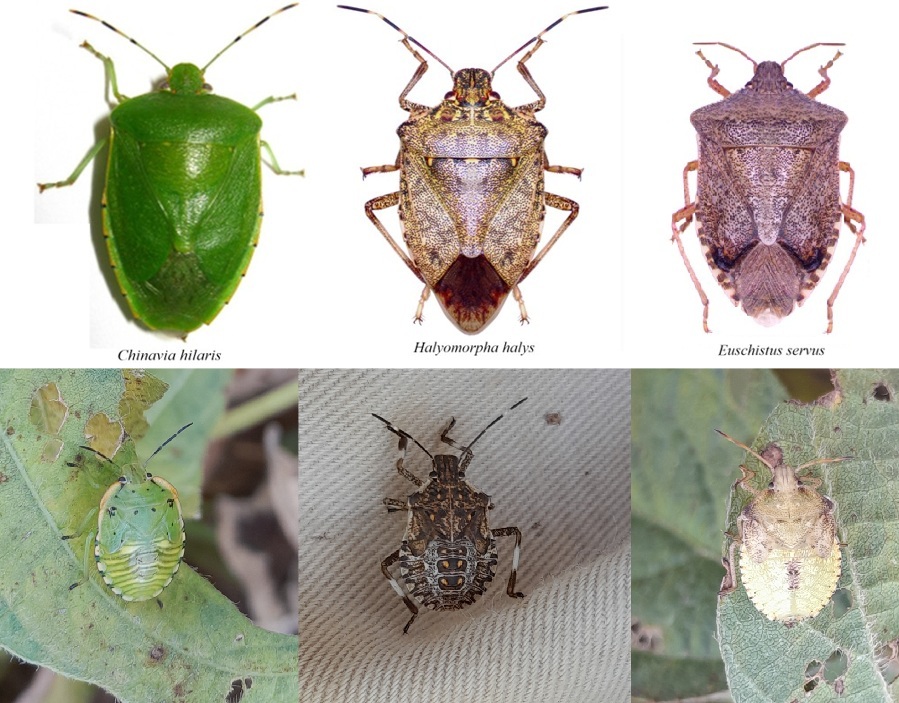
Stink bugs can be recognized by their distinctive shield-shaped body. The three species most frequently encountered in Kentucky soybeans are the Green Stink Bug (Chinavia hilaris), the Brown Marmorated Stink Bug (Halyomorpha halys), and the Brown Stink Bug (Euschistus servus) (Figure 3).
Green stink bug (Chinavia hilaris) adults are relatively large and bright green. Young nymphs are mostly black with orange, yellow, and white markings. Older nymphs become greener and look more similar to adults (Figure 3).
Brown marmorated stink bug (Halyomorpha halys) adults have a brown marmorated color and both nymphs and adults have distinct white bands on the antennae and legs (Figure 3).
Brown stink bug (Euschistus servus) adults are brown and usually have rounded shoulders. Nymphs are usually pale green and become more similar to adults as they develop. Unlike the brown marmorated stink bug, they do not have white bands on the antennae and legs (Figure 3).
Correct identification is useful because not every shield-shaped stink bug found in soybean is a pest and should not be included when determining treatment thresholds.
Damage
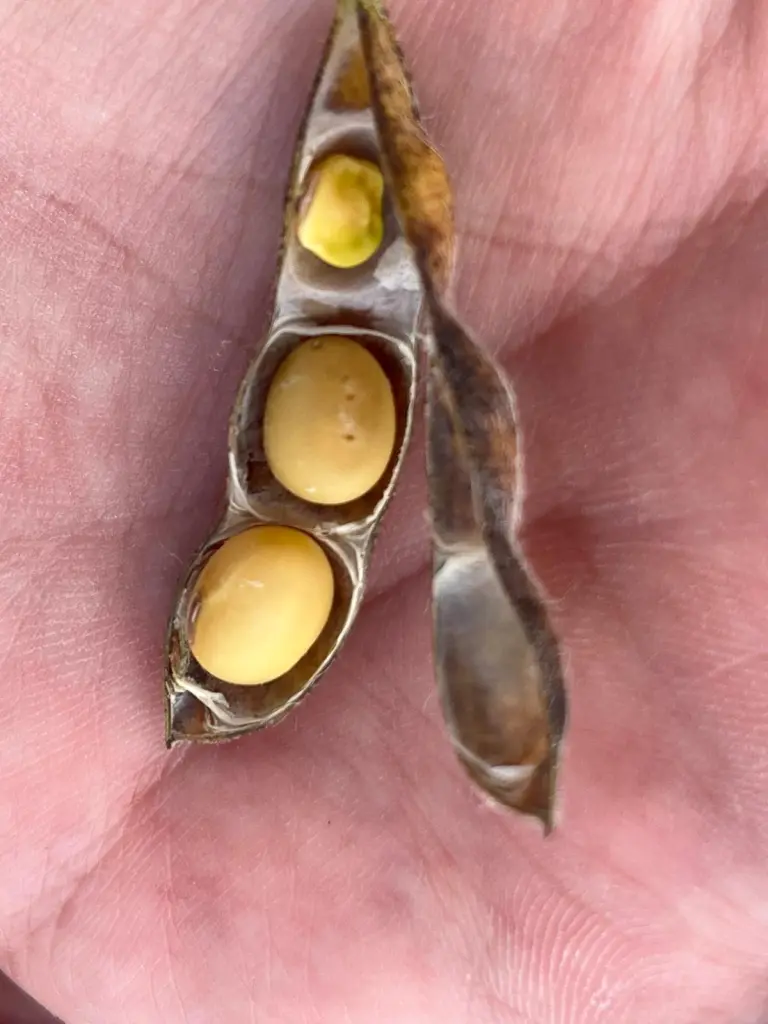
Stink bugs are important soybean pests because they feed directly on developing pods and seeds. They are piercing-sucking insects, and the extent of the damage depends on the growth stage of the soybean when injury occurs (Figure 4). Feeding during early pod and seed development can result in complete seed loss. As seeds develop and begin filling, stink bug injury results in shriveled and wrinkled beans. Feeding later during seed maturation may leave only puncture marks or slight deformation, which is why the damage can sometimes go unnoticed. Even when the damaged seeds may still be present, feeding can reduce seed size and weight, and facilitate infection by microorganisms, compromising quality and storability.
Some of our stink bug management trials from last season showed estimated yield losses of approximately 15 bu/A in untreated plots.
Scouting and Management
Fields should be sampled with a sweep net in at least five points across the field, and both pest adults and nymphs should be included in the count. The economic thresholds are reached at an average around 2-4 stink bugs per 10 sweeps (or 9 per 25 sweeps). If populations exceed these thresholds, insecticide applications may be required. Contact the local Extension agent for guidance on insecticide selection.
Take-Home Message
Many of Kentucky’s earliest full-season soybean fields are now beginning the maturation process and entering R7. At that point, the potential for stink bugs to cause significant yield loss is reduced, and insecticide applications are usually not justified. However, many later-planted soybean fields, particularly double-crop soybeans, remain still susceptible to significant injury.
Stink bugs are highly mobile insects and can move among soybean fields. As harvest of earlier-planted soybeans begins, the stink bugs tend to migrate to later-planted fields. Given the high stink bug populations currently present in parts of Kentucky, we should maintain periodical monitoring of soybean fields that are still between R3 and R6, especially double-crop fields. ∆
FELIPE C. BATISTA, ZENAIDA VILORIA AND DR. RIC BESSIN
UNIVERSITY OF KENTUCKY
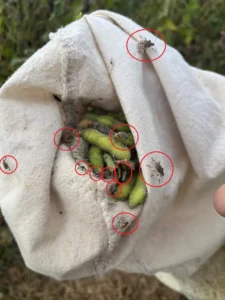
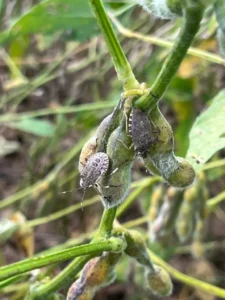
Figure 1. (Right)High stink bug populations observed feeding on soybean pods in Kentucky. (Photo: Zenaida Viloria).
Figure 2. (Left)High numbers of stink bugs (red circles)
observed in the sweep net after a single 10-sweep sample in a western Kentucky soybean field. (Photo: Zenaida Viloria).